By Princely Onyenwe | News Desk
OWERRI, Imo State — Deaf women from across the five South-East states have called on governments at the state and federal levels to strengthen policies on education, healthcare, employment, political participation, justice and social inclusion, insisting that disability must not become a barrier to equal opportunities and full participation in society.
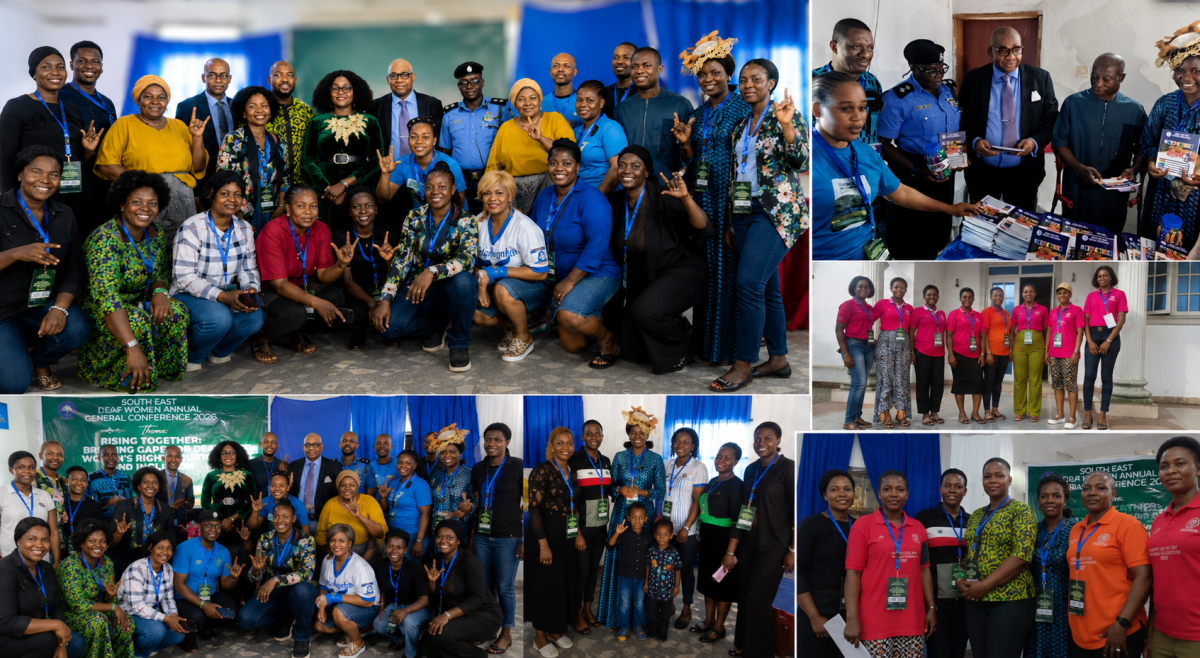
The demand was made at the 2026 South-East Deaf Women Annual Conference held at Best Way Hotel, Owerri, Imo State, where Deaf women and girls, government officials, education authorities, human rights advocates, development partners, security agencies, medical professionals, media representatives and other stakeholders gathered to deliberate on challenges affecting Deaf women and children.
The three-day conference, which commenced on Wednesday, August 5, was organised under the theme, “Rising Together: Bridging Gaps for Deaf Women’s Rights, Justice and Inclusion.”
The South-East Deaf Women Association, at the conference, called for the approval and introduction of Nigerian Sign Language as a subject in public and private schools across the South-East, stressing that greater knowledge of Sign Language would improve communication and educational access for Deaf children while helping to bridge communication gaps between Deaf and hearing members of society.
The association also demanded full inclusion and equal rights for Deaf women and children in education, healthcare, economic empowerment, political participation and decision-making processes, arguing that policies designed for inclusive development must adequately reflect the needs and experiences of persons with hearing disabilities.
It called on governments to provide qualified Sign Language interpreters in hospitals, government agencies and other essential public institutions, while also urging authorities to introduce Sign Language training for healthcare workers and other frontline service providers.
According to the association, effective communication remains a major barrier to the ability of Deaf people to access healthcare, justice, education and government services. It therefore urged institutions to adopt Deaf-friendly policies that would enable persons with hearing disabilities to access essential services independently and with dignity.
The women further called for scholarships for Deaf and hard-of-hearing students in federal and state institutions of learning, alongside the provision of specialised learning equipment and educational materials to enhance their academic development.
They also demanded greater representation of Deaf women in government appointments and leadership positions, as well as deliberate measures to facilitate the employment of qualified Deaf women in the public service.
The association maintained that inclusion should not be limited to consultations or policy statements, but should extend to actual representation, employment and participation in decisions that affect the lives of Deaf people.
Parents of Deaf children were equally urged to prioritise early identification, education and support for their children. The association stressed that early intervention and access to appropriate educational resources could significantly improve the development and future prospects of Deaf children.
A major highlight of the conference was the launch of the “Deaf Children Back to School” initiative by the South-East Deaf Women Association.
The initiative is aimed at identifying and supporting Deaf children who are out of school and helping them return to education. The association described it as part of its service to humanity and a practical intervention to ensure that no Deaf child is left behind because of disability.
The conference identified communication barriers and discrimination, inadequate funding for education and support, and a lack of specialised learning materials and equipment as some of the major challenges confronting Deaf children.
The participants consequently called for stronger collaboration among governments, parents, schools, civil society organisations, development partners and disability-focused organisations to address the challenges and create an environment where Deaf children can receive quality education and develop their full potential.
Among those who participated or were represented at the conference were Chief Ify Onyegbule, Director General of IBC; Dr. Samuelson Emehibe, JP, Special Adviser to the Imo State Governor on Disability Matters; Justice C. Uhuegbu, Esq., LP, a human rights advocate from Lagos; representatives of the Imo State Ministry of Education; and officials responsible for primary and secondary education in the state.
Also represented were the World Health Organisation, Medical Women’s Association of Nigeria, NAPTIP, Nigeria Security and Civil Defence Corps, Nigeria Police Force and other development and human rights stakeholders.
Dr. Sam Amadi, Director of the Abuja School of Social and Political Thought and Visiting Professor at the Emerald Energy Institute, University of Port Harcourt, delivered the keynote address through his representative, Mr. Nnamdi Umunnabuike.
Other stakeholders at the gathering included Mrs. Nwaijwe M.N.C., Desk Officer on Special Education, Imo State Ministry of Education; Mrs. Nwugo L.U., Senior Education Officer; Prof. Bernard-Thompson O. Ikegwuoha; Mr. Ohuabunwa G.C., who represented the Honourable Commissioner for Education; Mr. Agha, SENDA Zonal Coordinator, who also represented Mr. Nelson Chukwuemeka, NNAD National Vice President; and Mr. Sochi Madu, Chairman of IMSAD.
Representatives of NAPTIP’s Imo State Investigation and Monitoring Unit, Shell Camp Police Division, WHO, MWAN Imo State, NSCDC, media organisations, development partners and other stakeholders also participated in the conference.
In her welcome address, the South-East Zonal Women Leader, Mrs. Maria Chidimma Alufo-Ekpo, appreciated participants and stakeholders who travelled to Owerri and adjusted their schedules to support the conference.
Alufo-Ekpo said their presence demonstrated commitment to the rights and welfare of Deaf women and girls, describing the conference as an important part of the association’s advocacy activities.
She said empowering Deaf women and girls remained an unfinished responsibility, calling on governments, agencies, development partners, the media and other stakeholders to uphold the principle of leaving no one behind.
She emphasised the need for collective action to address the challenges confronting Deaf women and girls, noting that sustained collaboration among stakeholders would be critical to achieving meaningful improvements in their lives.
The conference ended with delegates and stakeholders renewing their commitment to advancing the rights, justice, dignity and inclusion of Deaf women and children across the South-East.
The association stressed that access to education, healthcare, employment, justice, leadership and political participation should be guaranteed as fundamental opportunities for Deaf women and children, rather than privileges determined by their hearing ability.
For inquiries on this news contact 9News Nigeria on +234 08036856526