By Princely Onyenwe | International Desk
INTERNATIONAL – The United Nations has renewed its demand for justice and stronger protection for journalists worldwide, warning that the growing culture of impunity is making journalism increasingly dangerous, with nearly nine out of every ten killings of media professionals remaining unresolved.
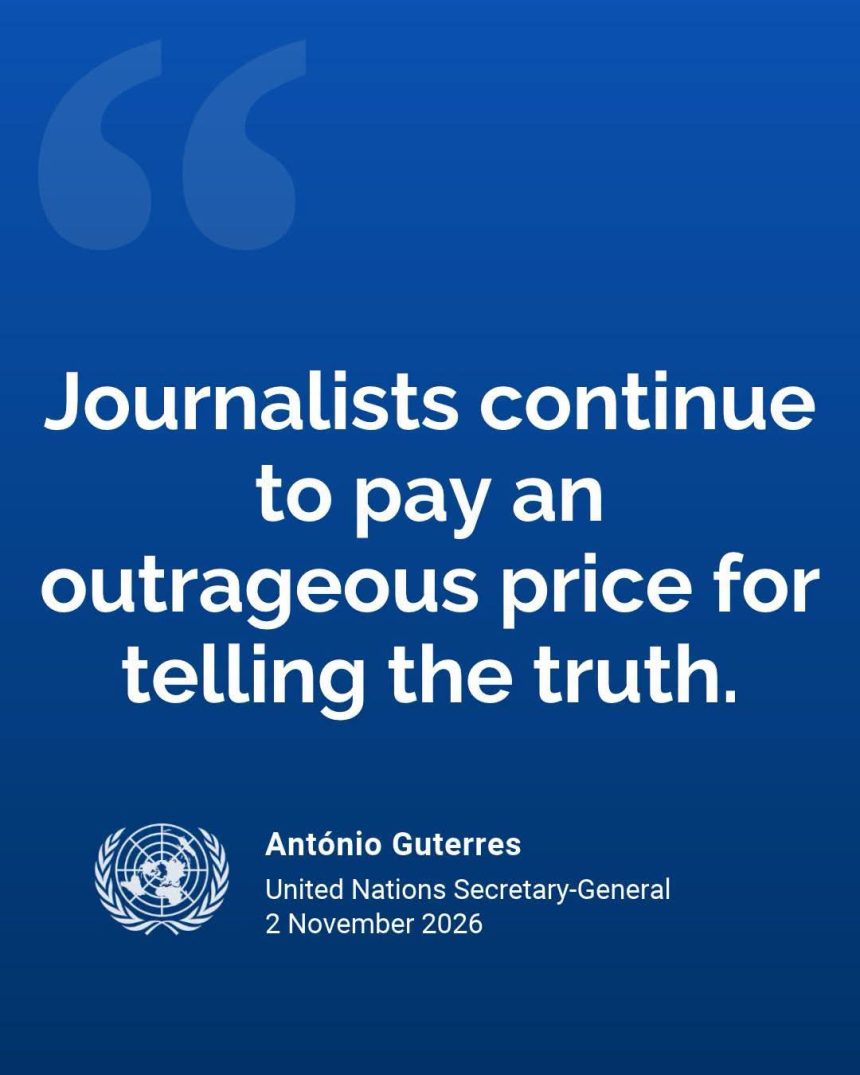
UN Secretary-General António Guterres issued the warning on Monday, November 2, 2026, during the International Day to End Impunity for Crimes against Journalists, declaring that journalists continue to pay an outrageous price for telling the truth.
The warning comes against the backdrop of disturbing figures released by the United Nations Educational, Scientific and Cultural Organization (UNESCO), which documented 189 journalists killed in violent attacks during 2024 and 2025, representing a 20 per cent increase compared with the preceding two-year period.
Of the 189 deaths, 127 occurred in conflict zones, accounting for approximately 67 per cent of the total. Even more disturbing is the emergence of drone warfare as a direct threat to media professionals, with 50 journalists reportedly killed by unmanned aerial vehicles during the two-year period.
UNESCO’s latest findings also indicate that the global impunity rate for journalist killings has risen to 86 per cent, reversing progress recorded since the organisation began monitoring the issue in 2012. This means that only about 14 per cent of recorded cases have been judicially resolved.
In his message, Guterres observed that journalists routinely face harassment, surveillance, legal intimidation, physical attacks, imprisonment and, in extreme cases, torture and assassination simply for performing their professional responsibilities.
He stressed that nothing should obstruct journalists from carrying out their work, describing independent journalism as fundamental to human rights, democracy and the rule of law.
The figures also expose a significant difference between conflict and non-conflict environments. UNESCO reports that the impunity rate in countries not experiencing armed conflict has declined from 94 per cent in 2012 to 77 per cent in 2026, demonstrating that sustained investigations and prosecutions can improve accountability.
Women journalists face additional dangers. UNESCO’s report recorded 14 women journalists killed during 2024 and 2025, with 93 per cent of their deaths occurring in conflict zones. Beyond physical attacks, women in the profession continue to experience online harassment, intimidation and gender-based violence.
The International Day to End Impunity for Crimes against Journalists was established by the United Nations General Assembly through Resolution A/RES/68/163 in 2013. November 2 was chosen in remembrance of two French journalists, Ghislaine Dupont and Claude Verlon, who were murdered in Mali on November 2, 2013.
This year’s global campaign, themed “Threats Evolve. Impunity Endures,” highlights how emerging technologies and modern weapons are changing the nature of attacks against journalists while accountability continues to lag behind.
The implications extend far beyond newsrooms. When journalists are killed, intimidated or imprisoned without consequences for their attackers, corruption, human rights violations, organised crime and abuses of public power become more difficult to expose.
For democracies across the world, the danger is particularly significant: silencing journalists also undermines citizens’ right to receive information, question authority and hold public institutions accountable.
As the world marks the 2026 observance, the central question remains whether governments will move beyond declarations and translate their commitments into credible investigations, successful prosecutions and practical protection for media professionals.
A society that cannot protect those who tell its truth risks allowing those who conceal it to operate without accountability.
For more inquiries on this news report contact 9News Nigeria on +234 08036856526