9News Nigeria International Desk
WASHINGTON / ABUJA / RIYADH — Tuesday, November 4, 2025.
As Nigeria continues to downplay U.S. President Donald Trump’s warning over what he described as “record killings of Christians,” Saudi Arabia is taking a markedly different diplomatic path — deepening talks with Washington and seeking formal U.S. defence guarantees in the face of growing regional insecurity.
The contrasting responses highlight two sides of Washington’s engagement with its international partners: Nigeria’s defensive posture over human rights concerns and Saudi Arabia’s calculated effort to strengthen military and political ties with the United States. Both developments underscore how the Trump administration is reasserting influence through a blend of moral diplomacy and strategic security realignment.
Trump’s remarks, made upon his return to Washington from his Florida residence, came after the U.S. re-designated Nigeria as a “Country of Particular Concern” — a classification reserved for nations accused of serious violations of religious freedom. The decision followed years of reports documenting targeted attacks against Christians by Boko Haram insurgents, suspected Fulani extremists, and armed militias across several northern and central states.
“They’re killing record numbers of Christians in Nigeria… killing them in very large numbers. We’re not going to allow that to happen,” Trump told reporters, hinting that military options were being considered. “Could be. I mean, other things. I envisage a lot of things.”
The U.S. move reignited international debate about Nigeria’s human rights record and the government’s handling of persistent sectarian violence. According to global watchdogs, Nigeria accounted for nearly 70 percent of Christians killed worldwide for their faith last year, with estimates suggesting that more than 50,000 Christians have died in religiously motivated attacks over the past decade.
Nigeria’s government, however, swiftly rejected the allegations.
Kimebi Imomotimi Ebienfa, spokesperson for the Ministry of Foreign Affairs, said Trump’s claims were exaggerated and failed to reflect the complexity of Nigeria’s security challenges.
“We are not proud of the security situation through which we are passing, but to go with the narrative that only Christians are targeted — no, it is not true. There is no Christian genocide in Nigeria,” Ebienfa said.
“We have acknowledged that killings have taken place in Nigeria, but those killings were not restricted to Christians. Muslims are being killed, traditional worshippers are being killed… The majority of victims are not from the Christian population.”
Independent analysts say the truth likely lies between both accounts, with extremist groups exploiting ethnic and religious fault lines amid widespread insecurity and weak governance. Despite repeated assurances from Abuja, insecurity continues to dominate Nigeria’s political landscape, damaging public trust and international confidence.
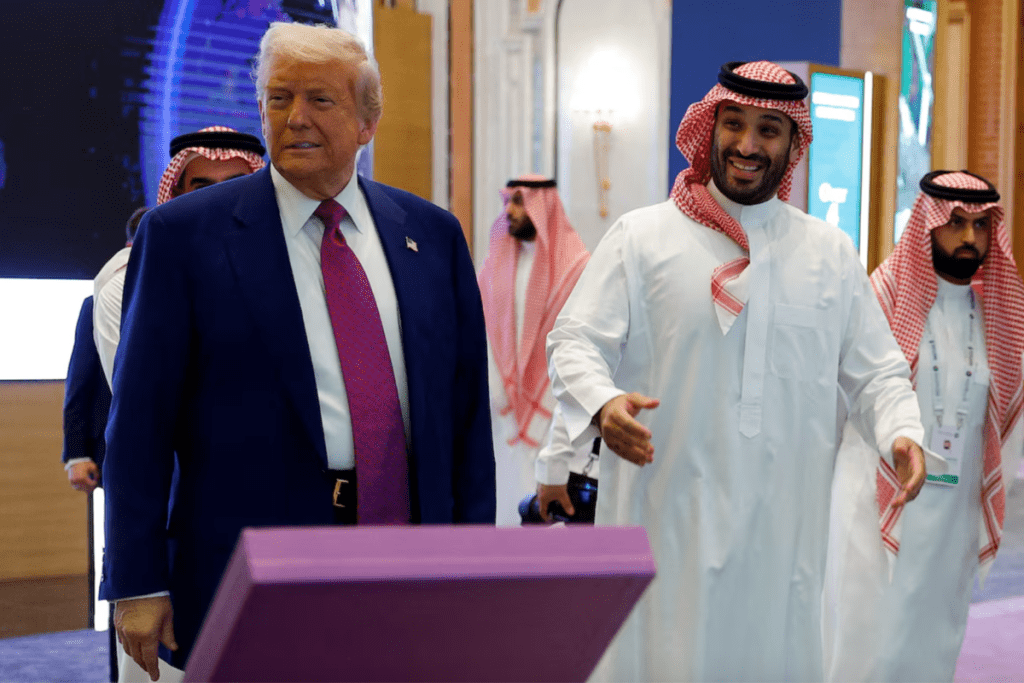
While Nigeria is fending off criticism, the White House is preparing to host Saudi Arabia’s Crown Prince Mohammed bin Salman on November 18, for what U.S. officials describe as a “strategic working visit.” The meeting will focus on defence cooperation, energy security, and the future of the Abraham Peace Accords — the U.S.-brokered initiative aimed at normalizing relations between Israel and Arab nations.
According to Reuters, discussions may include a potential U.S.–Saudi defence agreement, with hopes that a framework could be finalized during the Crown Prince’s visit. However, officials familiar with the matter cautioned that “details remain in flux.”
Saudi Arabia, a long-standing U.S. ally, is reportedly seeking formal American guarantees for its defence as well as access to advanced U.S. weaponry. During Trump’s previous visit to Riyadh, Washington agreed to an arms package worth nearly $142 billion, reinforcing the decades-old oil-for-security partnership that has defined U.S.–Saudi relations.
At the same time, Washington is pressing Riyadh to join the Abraham Accords, which have already seen the United Arab Emirates, Bahrain, Sudan, and Morocco normalize ties with Israel. Although Saudi Arabia has so far refrained, citing the absence of progress toward Palestinian statehood, Trump said in an interview with CBS’ 60 Minutes that he believes Riyadh “will ultimately join.”
“There are discussions about signing something when the Crown Prince comes, but details are in flux,” a senior U.S. official told Reuters.
The visit is expected to mark a significant moment for both nations, reflecting not only deepening defence ties but also Washington’s broader effort to consolidate influence in the Middle East amid evolving global alliances.
While Abuja faces mounting scrutiny for its handling of domestic insecurity, Riyadh appears to be capitalizing on its leverage as a crucial energy and defence partner.
Strategic Contrast
The contrasting dynamics between Nigeria and Saudi Arabia reflect two fronts of Washington’s evolving foreign policy — moral pressure on African governments accused of human rights abuses, and strategic cooperation with Middle Eastern allies vital to U.S. security interests.
Diplomatic observers say the timing of both developments is symbolic. While Nigeria faces international scrutiny over alleged religious violence, Riyadh is capitalizing on its geopolitical leverage to deepen ties with the U.S. and shape the post-conflict security order in the Middle East.
Analysts believe Trump’s dual approach — combining religious freedom advocacy with defence diplomacy — signals a recalibration of U.S. influence globally.
“It’s a message to the world,” said one Western diplomat. “The U.S. rewards credible partners who align with its interests, but it won’t hesitate to confront those falling short on human rights and stability.”
For now, the contrast between Nigeria’s defensive tone and Saudi Arabia’s diplomatic manoeuvring underscores the divergent paths nations are taking to navigate Washington’s renewed assertiveness under Trump’s watch.