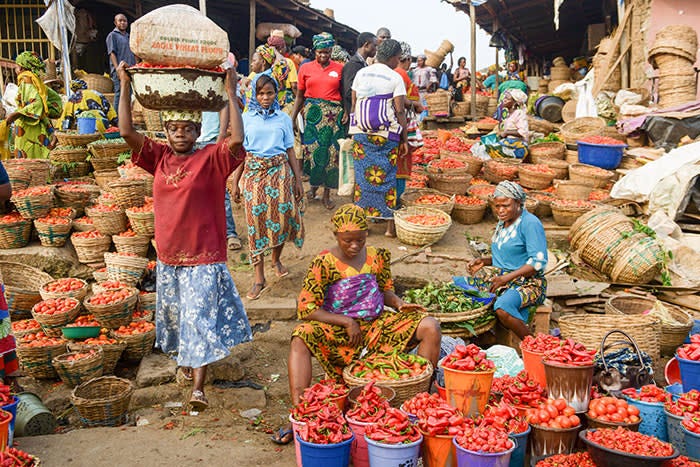
The cost of staple food items in Nigeria has risen dramatically over the past nine years, with most essentials now selling at between four to ten times their 2016 prices.
According to data from the National Bureau of Statistics (NBS), a comparison of food prices in 2016 and 2025 shows the extent to which inflation has eroded household purchasing power, particularly among low- and middle-income Nigerians.
In 2016, a single egg sold for an average of ₦42.03. By 2025, the price had surged to ₦252.79, meaning that one egg today costs the equivalent of six eggs in 2016.
Evaporated tinned milk (Peak, 170g), which sold for ₦154.47 in 2016, now costs ₦1,058.15, translating to seven tins at 2016 prices.
Similarly, the price of white garri rose from ₦191.02 per kilogram to ₦846.69, while yam tubers recorded one of the steepest increases, climbing from ₦202.89 per kilogram in 2016 to ₦2,023.83 in 2025, a tenfold rise.
Other staples have followed the same trend. White beans increased from ₦295.85 per kilogram to ₦1,587.82, while a loaf of sliced bread now sells for ₦1,675.51, up from ₦305.27 in 2016.
The price of imported long-grain rice rose from ₦388.79 per kilogram to ₦2,255.28, making one kilogram today equivalent to nearly six kilograms in 2016.
The data displays the scale of food inflation confronting Nigerian households, as rising prices continue to outpace wage growth.
The surge is attributed to a combination of factors including currency depreciation, higher transportation and energy costs, insecurity affecting food production, and supply chain disruptions.
With food accounting for the largest share of household expenditure in Nigeria, the sustained rise in prices has heightened concerns about food security and living standards across the country.