By Abubakar H. Muhammad (9News Nigeria, Northeast)
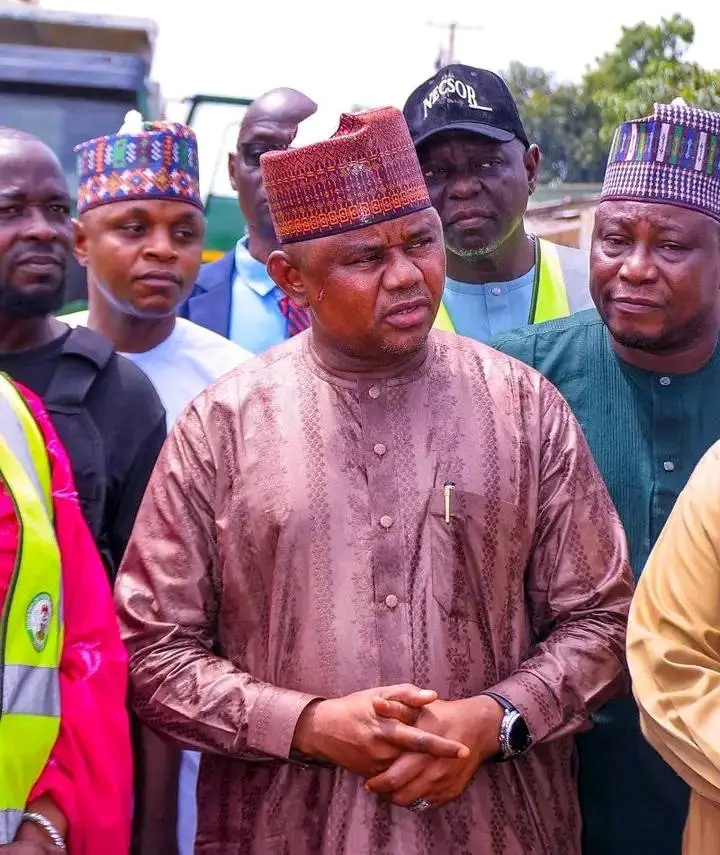
Until his appearance as contender for Borno State’s number one seat of power, very little is known about Engr Mustapha Gubio in the public space.
This is largely due to his reserve nature and has not invested adequately on the media.
With his emergence now as Borno State’s APC consensus governorship candidate for 2027, here are five key things to know about Engr. Mustapha Gubio.
1. He’s a Fellow of the Nigerian Society of Engineers
Engr. Gubio holds the title FNSE, meaning Fellow of the Nigerian Society of Engineers. This is the highest grade of NSE membership, reserved for engineers with at least 10 years post-qualification experience and significant contributions to the profession.
His focus is civil and structural engineering, with an emphasis on infrastructure, housing, and post-conflict reconstruction.
2. He rebuilt communities from the rubble of insurgency
When Governor Zulum tapped him as Commissioner for Reconstruction, Rehabilitation and Resettlement, Gubio became the engineer of Borno’s return to normal life.
In Ngarannam, he oversaw a joint effort with the UNDP that didn’t just put roofs over 804 displaced families. Each family went home with cattle, goats, ₦100,000 cash, food, and clothing, in a resettlement so complete that the Chief of Staff to the President came to Maiduguri to commission it.
In Auno, 24km from the state capital, he delivered 500 housing units shaped by how people actually live. The designs respected local culture: apartments were separated by fencing, rooms were sized for extended families, and toilets were built outside the main structure. Boreholes were sunk before the first family moved in.
Across Bama, Konduga, Damasak and Mafa, his brief expanded beyond houses to schools and clinics, restoring the skeleton of local government in places where Boko Haram had tried to erase it.
For Gubio, reconstruction meant closing a housing deficit that predated the insurgency, not just replacing what was destroyed.
3. He turned abandoned projects into homes through partnerships
When he moved to Works and Housing, Gubio confronted a familiar problem: uncompleted estates dotting Maiduguri, money sunk and nothing to show for it. His answer was to bring in private capital.
With Thinklab Group Limited, he structured a deal to revive 594 abandoned units: 404 in Bakassi GRA along Biu Road and 190 in Teacher’s Village at Pompomari. The agreement went beyond finishing walls. Thinklab committed to roads, power, water, and landscaping, turning concrete shells into livable estates. In return, the state contributed the uncompleted buildings as equity, creating a 60-40 revenue split that gave government value without new budget pressure.
Gubio framed it as housing for people coming out of IDP camps, for low-income families, and for public servants who had waited years for government quarters. It was engineering mixed with financing, a way to deliver homes without waiting on allocations.
4. He put over 2,000 families into houses across Borno
The Rural Housing Transformation program became his signature outside Maiduguri. The plan was simple: 100 units in each of 6 LGAs, spreading state presence into places that rarely saw government projects.
When he inspected sites in Biu township and Azare in Hawul LGA, he announced that roads and drainage would follow the houses, because shelter without access was incomplete. Add those 600 rural units to the 1,304 he delivered as RRR Commissioner in Ngarannam and Auno, then add the 594 he revived through PPP, and Gubio’s housing footprint crosses 2,400 units.
Each project carried the same philosophy: boreholes before handover, fencing for privacy, designs that fit the community. Whether for IDPs in Ngarannam or rural families in Biu, the houses were built to be lived in, not just commissioned.
Gubio’s Ministry of Works and Housing oversaw Civil Works (Roads and Bridges), Building Construction, Housing and Urban Renewal, and Mechanical/Electrical Services.
5. He Managed Borno’s Infrastructure Portfolio
He supervised rehabilitation of key corridors like Maiduguri–Bama and Monguno–Kukawa roads. His tenure is linked to over 1,000 capital projects under the Zulum administration, with a reputation for technical depth and administrative discipline.
As the election period is fast approaching, it is left for Borno electorates to decide whether or not, if they want to tap into his wealth of experience and commitment to rebuilding the state.