By Francis Xavier U.
In every democracy, moments of political movement, alliances, coalitions, even defections, are not inherently alarming. They can signal growth, ideological realignment, or the evolution of public policy priorities. But in Nigeria today, the frequency, timing, and motivations behind political defections have turned what should be a legitimate democratic exercise into a troubling spectacle, one that raises deeper questions about moral responsibility, political identity, and the true meaning of representation.
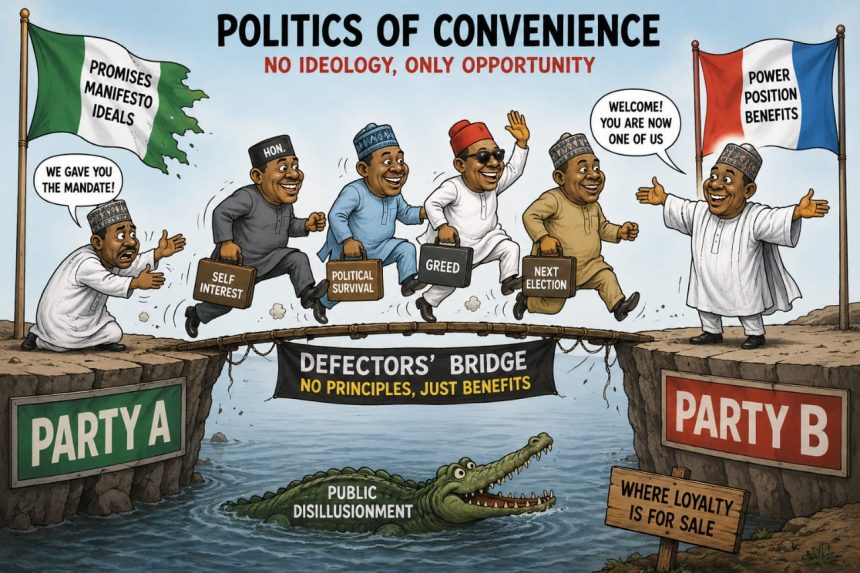
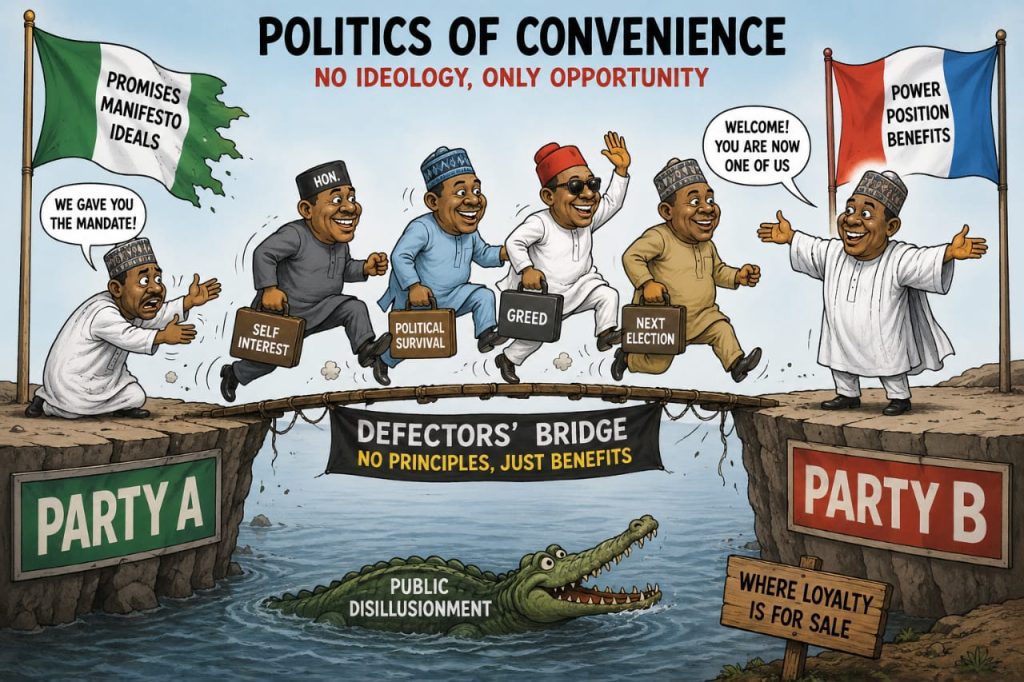
Across party lines, elected officials glide from one platform to another with unsettling ease, often without offering the electorate any clear ideological justification. Campaign promises made under one party’s manifesto are quietly abandoned for the convenience of another. Mandates given by the people are treated less as sacred trusts and more as transferable assets, negotiated in backrooms, exchanged for political survival, or leveraged for personal advancement.This is where the crisis lies, not merely in defection itself, but in defection without conviction.At its heart, democracy thrives on trust. Citizens do not merely vote for individuals; they invest in ideals, visions, and party identities.
When politicians discard these affiliations at the slightest challenge, without meaningful engagement with their constituents or any clear ideological basis, it reinforces a troubling notion: that party loyalty is transactional, and public trust is expendable.An ideal democracy rests on more than just elections; it is sustained by values, integrity, accountability, transparency, and above all, fidelity to the people’s mandate. When politicians defect without consulting their constituents or articulating principled reasons, they undermine the very foundation of democratic trust. The ballot becomes devalued.
The voter becomes irrelevant. And politics begins to resemble a marketplace where loyalty is fluid and ideology is optional.In mature democracies, party affiliation is often rooted in defined philosophies, clear positions on governance, economy, social policy, and national direction. Movement across parties, when it happens, is typically accompanied by robust public explanation, even resignation and re-election in some cases, to reaffirm legitimacy. It is understood that power is derived from the people, not merely occupied by individuals.
Nigeria must begin to insist on this higher standard.The current pattern of defections reflects a deeper institutional weakness: the erosion of party ideology. When political parties become indistinguishable in vision and practice, they cease to be vehicles of policy and become mere platforms for ambition. In such an environment, defection is no longer a matter of conscience, it becomes a strategy. And when strategy overtakes principle, democracy suffers.Yet, the responsibility does not lie with politicians alone. The political culture we tolerate shapes the leadership we produce.
When defections are met with silence instead of scrutiny, when opportunism is rewarded with applause instead of accountability, we collectively lower the bar of democratic expectation.It is time to reset that standard.Political actors must be reminded firmly and consistently, that public office is a moral contract. It is not enough to win elections; one must honour the spirit in which that victory was granted. If a change of political direction becomes necessary, it must be done with transparency, consultation, and a willingness to return to the people for validation. Anything less is a breach of democratic ethics.Institutions, too, have a role to play. Electoral laws and constitutional provisions around defection must be strengthened and enforced, not as punitive tools, but as safeguards for democratic integrity.
The goal is not to restrict political freedom, but to ensure that such freedom is exercised responsibly.Ultimately, democracy is not just about power, it is about trust. And trust, once eroded, is difficult to rebuild.A disturbing trend is steadily defining Nigeria’s political space, one where the denial of party tickets or anxiety over uncertain political futures prompts an instant switch to another platform. What ought to inspire reflection, internal reform, or principled dissent is too often reduced to a swift exit fueled by self-interest.
This ease of political movement is not just disappointing; it undermines the moral foundation upon which democracy stands.This rising wave of defections born out of denied ambitions exposes a deeper weakness, the lack of firm ideological structures within political parties. When parties become indistinguishable and allegiance becomes fluid, politics is stripped of substance. The electorate is left uncertain, disenchanted, and increasingly detached from a system meant to represent their collective will.More troubling is the example this sets. A system where politicians can simply switch allegiances when faced with difficulty weakens internal party democracy. Instead of confronting injustice or working to strengthen institutions, defection becomes the path of least resistance. In doing so, accountability suffers, resilience fades, and opportunism is inadvertently rewarded.Democracy demands higher standards.
It calls for leaders who remain steadfast in their convictions, even when the path is uncertain. Public office should never be treated as a fallback option or a personal entitlement, but as a duty that must be earned through integrity, consistency, and genuine respect for the people.Addressing this challenge requires both ethical reawakening and structural reform. Political actors must embrace responsibility, ensuring that any decision to defect is guided by principle, not convenience. Simultaneously, party systems and legal frameworks must evolve to discourage reckless cross-carpeting and protect the sanctity of the mandate entrusted by voters.In the end, the responsibility also rests with the electorate. Citizens must look beyond campaign rhetoric and examine patterns of conduct.
They must demand accountability, question intent, and reject the normalization of political opportunism.For when leaders choose escape over principle, it is not just their credibility that suffers, democracy itself is diminished.Nigeria stands at a crossroads. The growing culture of political defection can either continue unchecked, deepening public cynicism and weakening institutions, or it can serve as a turning point, a moment to demand better, to insist on principle, and to reaffirm the moral compass of our democracy.The choice is ours.
Because in the end, a democracy without moral discipline is not just fragile, it is hollow.