By Obinna Ejianya (9News Nigeria – Melbourne, Australia)
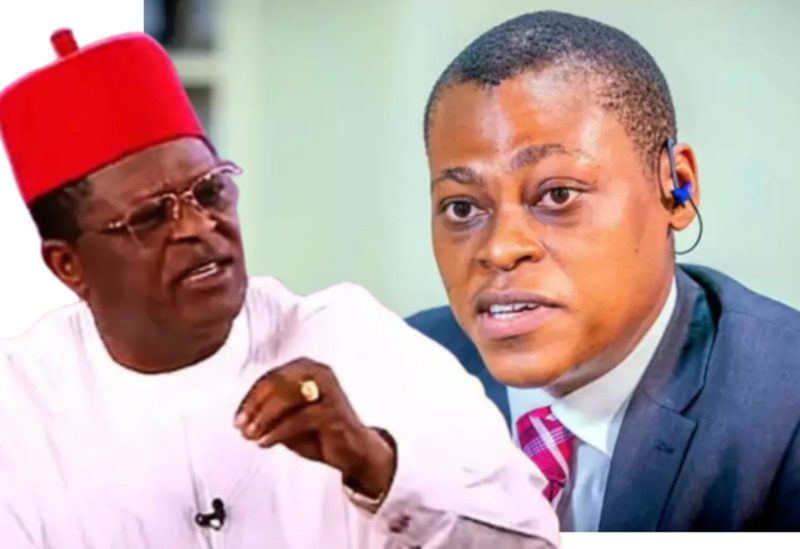
In a democratic society, the media is not merely a messenger—it is the conscience of the nation. It serves as a mirror reflecting both the triumphs and failures of governance. In Nigeria, where transparency and accountability often fall victim to political expediency, the recent confrontation between Arise TV journalist Rufai Oseni and the Minister of Works, David Umahi, offers a sobering glimpse into the fragile relationship between the press and power. What unfolded on live television was not just a heated exchange; it was a defining moment for Nigerian journalism and the struggle for public accountability. Media practitioners, including journalists, must never demonstrate complicity toward leaders who have been found wanting. They must act as mirrors that reflect, question, and check those in public service—mediating competently and honorably in the discharge of their duty.
During a recent interview on Arise TV’s The Morning Show, Rufai Oseni pressed Minister Umahi to reveal the cost per kilometer of the controversial Lagos–Calabar Coastal Highway project—a multi-trillion-naira infrastructure development initiated under the Tinubu administration. The journalist’s persistence was met with resistance, and what began as a simple question soon turned into a fiery confrontation. Umahi, visibly irritated, dismissed Oseni’s question as “nonsensical,” arguing that every kilometer of the project was unique and could not be quantified uniformly. He went further, telling Oseni to “keep quiet” and asserting that the anchor was “too small” to question him. That single moment laid bare the underlying tension between authority and accountability in Nigeria’s public life.
The Lagos–Calabar Coastal Highway, estimated to cost over ₦15 trillion, has sparked significant controversy since its announcement. Many Nigerians have questioned the opaque nature of its procurement process, the lack of competitive bidding, and the absence of a clear cost breakdown. Oseni’s insistence on transparency therefore, echoed the concerns of millions who wonder whether public resources are being used judiciously or siphoned through politically connected contracts. Asking for the cost per kilometer is neither sensational nor disrespectful—it is the essence of accountability journalism. It is the people’s right, through the media, to know how their taxes are spent.
Public reaction to the televised encounter has been polarized. On social media, many Nigerians hailed Rufai Oseni as a fearless journalist doing exactly what the media should—speaking truth to power without fear or favor. They applauded his courage in confronting a powerful minister who seemed uncomfortable with scrutiny. Others, mostly political loyalists and supporters of the ruling party, accused Oseni of arrogance and unprofessionalism, insisting that he was disrespectful to a government official. APC chieftain Joe Igbokwe even vowed to boycott Arise TV unless Oseni was removed, describing him as rude and combative. Yet beneath these divided opinions lies a deeper question: why should a public official feel insulted when asked to account for public spending?
Nigeria’s political culture has long been one where power shields itself with entitlement. Ministers, governors, and other high-ranking officials are often treated with deference, even by the press, as though holding public office places them above questioning. This is precisely what fuels impunity and erodes public trust. In that context, Rufai Oseni’s interrogation of Umahi was not an act of provocation but of patriotism. His line of questioning embodied the true spirit of journalism—a watchdog role that demands openness from those entrusted with public resources.
Minister Umahi, on the other hand, missed an opportunity to demonstrate leadership. Rather than address the questions with facts and composure, he responded with hostility and condescension. Transparency is not optional in governance—it is a duty. Telling journalists to “keep quiet” when they seek information only deepens the perception that something is being hidden. The credibility of any government depends not just on the work it claims to do but on its willingness to explain and defend it with evidence and respect.
This incident also exposes the wider decline in Nigeria’s political accountability ecosystem. When journalists who challenge authority are vilified, and sycophants who flatter power are celebrated, the country’s democratic institutions weaken. The media’s role is not to please politicians or make them comfortable; it is to ensure they remain answerable to the public. Rufai Oseni’s style may be blunt, but substance must never be sacrificed for decorum. The truth is that Nigeria needs more journalists who dare to ask uncomfortable questions and fewer who act as mouthpieces for those in power.
To his credit, Rufai Oseni has consistently demonstrated a deep understanding of what journalism should represent—objectivity, courage, and an unwavering commitment to social justice. He has become a symbol of resistance to the culture of silence that has crippled Nigeria’s democratic accountability. His work reflects the belief that journalism is not a career for comfort seekers but a calling for truth seekers.
If the confrontation between Oseni and Umahi teaches anything, it is that the health of a democracy depends on how its leaders handle scrutiny. Transparency is not a favor granted by those in power; it is a fundamental right owed to the people. The media must remain fearless, factual, and firm. Politicians, in turn, must learn to see journalists not as enemies but as partners in nation-building.
In the end, history will not remember the anger of those who were questioned, but the courage of those who dared to ask. Rufai Oseni stands today as a reminder that journalism, when practiced with integrity, remains one of the last defenses of democracy in Nigeria. Accountability must never be silenced—especially not by those who owe it most to the people they serve.