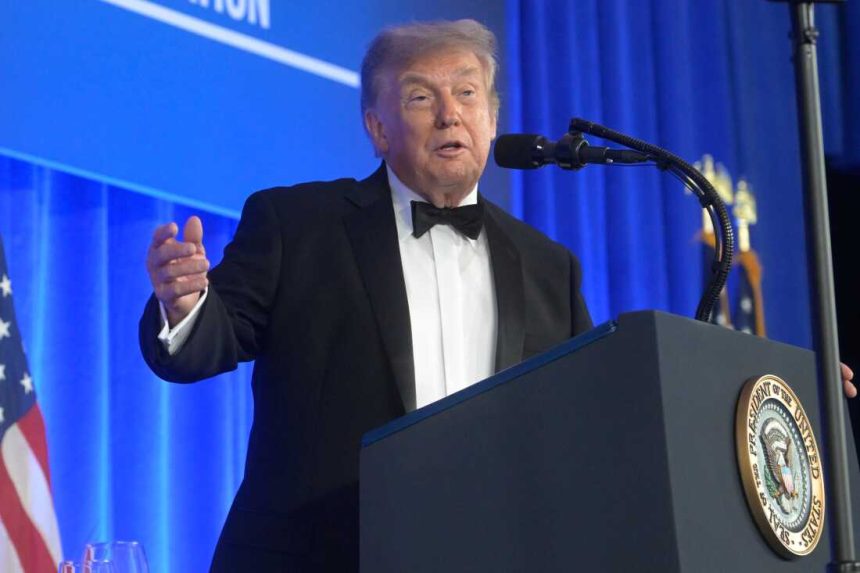
U.S. President Donald Trump has declared that he intends to seek a fourth term in office, despite constitutional provisions that bar any individual from being elected president more than twice.
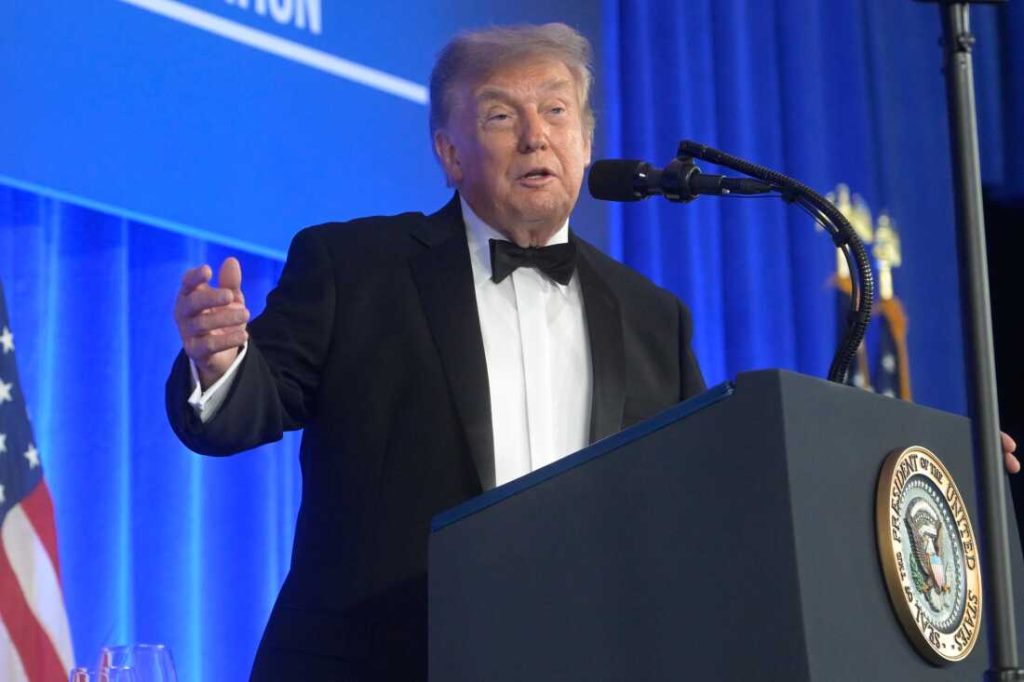
Speaking at the rescheduled White House Correspondents’ Dinner, Trump told an audience of journalists and political figures:
“I am pleased to announce my intention to run for a fourth term as President of the United States. I will be doing that. I won three times, now I’m going to do it again.”
The remarks, delivered in a speech laced with humour and political jabs, quickly generated reactions, both from home and abroad.
Many political analysts interpreted the comments as a joke made in keeping with the tone of the event, while others viewed them as another example of Trump’s repeated references to extending his time in office.
Why a fourth term is constitutionally impossible for now ?
Under the 22nd Amendment to the U.S. Constitution, ratified in 1951, “No person shall be elected to the office of the President more than twice.”
The amendment was introduced after President Franklin D. Roosevelt became the only American president to win four elections.
Trump is currently serving his second elected term.
Although he continues to insist that he actually won the 2020 election, the certified results recognized Joe Biden as the winner, meaning Trump has officially been elected president twice, once in 2016 and again in 2024.
Could the Constitution be changed?
In theory, yes, but the process is extraordinarily difficult.
Amending the U.S. Constitution requires:
- Approval by a two-thirds majority in both the House of Representatives and the Senate; and
- Ratification by three-quarters of the 50 U.S. states (38 states).
Given the deep political divisions in the United States, constitutional scholars widely regard such an amendment as highly unlikely if not completely impossible.
Are there any legal loopholes?
Legal professionals have occasionally debated whether a two-term president could return to the White House as vice president and later assume the presidency if the president resigned or became unable to serve.
However, that interpretation remains highly disputed, and the 12th Amendment raises additional constitutional barriers by restricting eligibility for the vice presidency.
No court has endorsed such a pathway, and it has never been tested.
Whether made in jest or not, Trump’s remarks are consistent with previous comments suggesting he would like to remain in office beyond the traditional two-term limit.
The statement is likely to fuel further arguments over constitutional limits, presidential power and the future direction of American politics ahead of the next election cycle.
Meanwhile, for now, the U.S. Constitution remains clear: a fourth—or even a third, elected presidential term is not legally permitted unless it is amended.