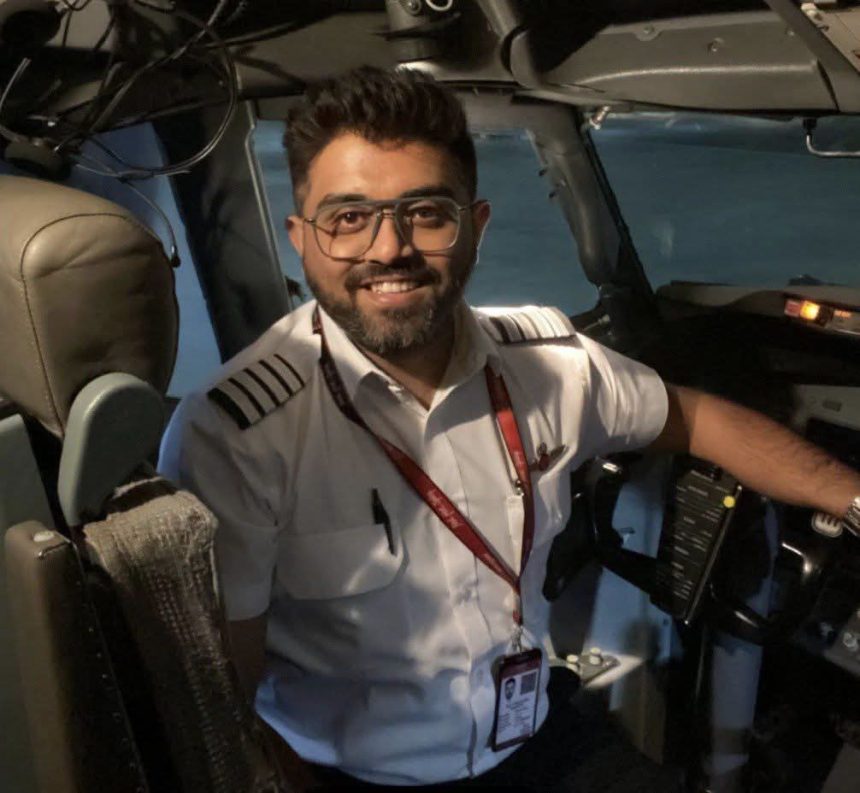
- Captain Machchhar, passengers and crew unite to avert disaster
By Princely Onyenwe | Editorial Desk
There are moments when nationality, religion, borders and politics become insignificant, leaving humanity itself to answer one fundamental question: what will you do when another human life is in your hands?
That question was confronted at terrifying altitude on Wednesday, September 30, 2026, aboard flydubai Flight FZ1073, which departed Dubai International Airport at about 7:05 a.m. local time for Tel Aviv. The Boeing 737 MAX 8 was carrying 174 people when an extraordinary cockpit emergency turned a routine journey into a fight for survival.
As the aircraft travelled towards Israel, Captain Smit Machchhar, an Indian pilot, was stabbed by his co-pilot and the aircraft plunged more than 14,000 feet in less than 30 seconds. Israeli officials said the co-pilot appeared to be attempting to crash the aircraft, while the wider circumstances and motive remain under investigation.
Seriously wounded, Machchhar nevertheless managed to open the cockpit door. That decision proved crucial. Passengers and crew rushed forward, overpowered the attacker and helped restore access to the cockpit. Two additional pilots who were aboard then took control and helped bring the aircraft safely down.
The aircraft was diverted to Tabuk, Saudi Arabia, where it landed safely at Prince Sultan bin Abdulaziz International Airport. All 174 people aboard survived the ordeal before the passengers were subsequently transported onward to Israel.
Captain Machchhar’s courage opened the door, but others stepped through it. Passengers confronted the danger. Crew members responded. Fellow pilots used their training when it suddenly became indispensable. A medical professional among the passengers also assisted the injured captain.
There were different nationalities, different backgrounds and different fears, but one overriding instinct: the saving of human life. That distinction matters because celebrating Machchhar should not diminish the extraordinary courage of everyone who acted aboard Flight FZ1073. His role was central, but the survival of 174 people was ultimately a collective achievement.
The world may continue to examine exactly what happened inside that cockpit and what motivated the co-pilot. Israeli authorities have described the episode as an apparent attempt to crash the aircraft, while investigators in Saudi Arabia and elsewhere are examining the circumstances and motive. Until that investigation is complete, the responsible position is to distinguish what has been established from what remains under examination.
What cannot easily be disputed, however, is what happened when danger arrived. At that point, people acted. They rose against the threat.
A wounded captain fought to create an opening. Passengers moved towards the danger rather than away from it. Crew members responded under extraordinary pressure. Other pilots took over when the aircraft’s survival depended upon their expertise. And that is perhaps the most enduring lesson of Flight FZ1073.
At a time when the world is increasingly divided by nationality, religion and politics, an Indian captain, Israeli passengers and other individuals aboard one aircraft demonstrated something remarkably simple: when human lives are at stake, courage has no nationality.
Captain Smit Machchhar is now being hailed internationally for his actions and is recovering from his injuries. Indian Prime Minister Narendra Modi and Israeli Prime Minister Benjamin Netanyahu have publicly praised his courage.
But the deeper tribute should extend beyond one man. The 174 people aboard Flight FZ1073 were not saved by nationality. They were saved by people who, in a moment of extraordinary danger, chose to act.
High above the clouds, when fear threatened to take control, courage took the controls back. That is the enduring image from Flight FZ1073: a wounded captain, passengers, crew members and fellow pilots refusing to surrender 174 lives to a moment of terror.
And perhaps that is the question this remarkable flight leaves for the world: when everything appears to be falling apart, will we choose fear—or will we choose courage? A terrible incident was averted by courage, cooperation and a determination to save human life.