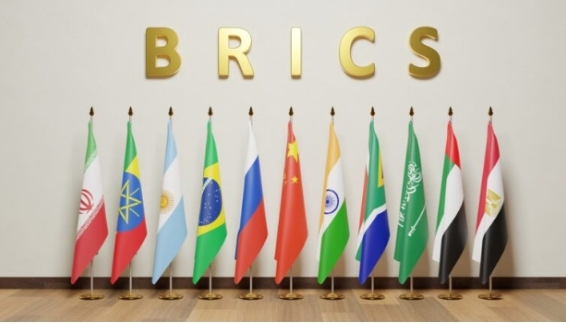
NEW DELHI — African countries could gain wider access to trade, investment, development finance, technology and new markets under the economic cooperation framework outlined in the BRICS New Delhi Declaration.
The declaration, adopted at the 18th BRICS Summit in New Delhi, India, places particular emphasis on strengthening cooperation among emerging markets and developing countries, including those in Africa.
BRICS leaders said their expanded partnership would promote sustainable development, inclusive growth and greater participation of developing countries in global economic decision-making.
For Africa, one of the most significant opportunities lies in development finance.
The declaration supports the growing role of the New Development Bank (NDB) in meeting infrastructure and development needs across emerging markets and developing countries.
It calls for the NDB to expand its capacity to mobilise resources, increase local-currency financing, diversify funding sources and support infrastructure investment, economic integration and projects aimed at reducing inequality.
This could provide African economies with another avenue for financing roads, railways, energy projects, water systems, digital infrastructure and other development programmes.
The declaration also welcomes progress on the BRICS Multilateral Guarantees initiative, which it says has the potential to mobilise private capital, improve the creditworthiness of projects and reduce financing costs in BRICS countries and the wider Global South.
For African governments struggling with expensive infrastructure financing, such mechanisms could help attract private investment into projects that might otherwise face difficulty securing affordable capital.
Bigger markets for African products
Trade is another major area of potential benefit.
The declaration commits BRICS members to improving global value chains and creating greater opportunities for emerging and developing economies to move into higher-value manufacturing and production.
It specifically calls for trade and investment initiatives, technology transfer, technical cooperation and the development of productive capacities.
That could be important for African economies seeking to move away from dependence on exporting raw commodities.
Rather than exporting crude minerals, agricultural commodities or other raw materials, African producers could potentially gain greater opportunities to participate in processing, manufacturing and other higher-value activities.
The declaration also recognises the importance of special economic zones in promoting trade, investment, industrial cooperation and integration into global value chains.
Cheaper and faster cross-border payments
African businesses could also benefit from efforts to improve cross-border payment systems.
The BRICS Payment Task Force is examining mechanisms for making cross-border payments faster, cheaper, more accessible, efficient, transparent and secure.
The declaration also records discussions on using BRICS local currencies for trade settlements and investment, although it stresses that there is no single approach suitable for every country.
For African economies, greater use of local-currency settlement mechanisms could potentially reduce some of the costs and currency pressures associated with international trade.
However, the declaration does not establish a single BRICS currency or automatically require African countries to abandon existing international payment systems.
Agriculture and food security
Agriculture is another area where the declaration could have direct relevance for Africa.
BRICS leaders proposed continued work on a BRICS Grain Exchange, with the possibility of expanding cooperation beyond grain into other agricultural commodities.
They also called for stronger intra-BRICS trade in agricultural products and inputs, resilient supply chains, improved agricultural value chains and sustainable farming practices.
The declaration further supports cooperation on digital agriculture, agroecology, regenerative agriculture, fisheries and aquaculture.
For African countries, these initiatives could create opportunities for agricultural technology transfers, improved access to inputs, expanded markets and greater cooperation on food production.
Africa’s minerals could attract more investment
Africa’s enormous deposits of critical minerals could become another important area of cooperation.
The declaration calls for reliable and resilient supply chains for critical minerals while emphasising value addition and economic diversification in resource-rich countries.
It also recognises the importance of critical minerals to clean-energy technologies, energy security and resilient supply chains.
This is significant for African economies because it places emphasis not only on extracting minerals but also on increasing their economic value within resource-rich countries.
For countries possessing lithium, cobalt, copper, manganese, graphite, nickel and other strategic minerals, deeper cooperation could potentially support investment, processing capacity, technology transfer and industrial development.
Energy and industrial development
The declaration also identifies energy security as fundamental to economic development.
BRICS countries committed to cooperation covering energy security, infrastructure, renewable energy, hydrogen, nuclear energy, hydropower, energy storage and other technologies.
It also recognises the need for stronger and more resilient energy supply chains.
For Africa, where inadequate electricity supply remains a major constraint on industrialisation in many countries, access to investment and technical cooperation in energy could have wider economic implications.
The declaration additionally promotes cooperation in industrialisation, manufacturing, Industry 4.0, robotics, artificial intelligence and support for start-ups and small and medium-sized enterprises.
It welcomes the BRICS Incubator Network and further consideration of a BRICS Startup Innovation Fund.
Technology and digital economy
The digital economy is another potential area of opportunity.
BRICS leaders described information and communication technologies as a major driver of socio-economic growth and digital transformation.
They endorsed greater cooperation in digital infrastructure, digital public goods, digital skills, research, capacity building and interoperable digital systems.
The declaration also recognises artificial intelligence as a major opportunity for economic growth and sustainable development, while calling for international cooperation to make AI safer, more inclusive and accessible, particularly for countries of the Global South.
For African economies, access to these networks could support digital payments, e-government, fintech, education, health services, business development and technology-driven employment.
Infrastructure and transport
Infrastructure is another central theme.
The declaration supports greater cooperation in transport policy, investment, technology and capacity building to develop sustainable and resilient transport infrastructure.
It also welcomes a BRICS Logistics Supply-Chain Cooperation Framework and discussions around a BRICS Railway Research Network.
Improved transport and logistics connections could help African economies reduce the cost of moving goods and strengthen links between producers, ports, industrial centres and international markets.
More African influence in global institutions
Beyond direct economic benefits, BRICS is also seeking greater representation for developing countries in global institutions.
The New Delhi Declaration supports increased participation and representation of emerging and developing economies, particularly countries from Africa, Asia and Latin America, in global decision-making structures.
The declaration also explicitly recognises the aspirations of African countries for greater representation in the United Nations Security Council and refers to the Ezulwini Consensus and Sirte Declaration.
For Africa, this could strengthen the continent’s collective voice on international economic, financial, security and development issues.
Climate finance and resilience
Climate change presents another area of potential cooperation.
The declaration recognises the financial constraints facing developing countries and calls for greater attention to debt sustainability, fiscal space, sustainable development and climate financing.
It also supports BRICS cooperation on climate research, carbon markets, adaptation and climate resilience.
For African countries vulnerable to droughts, floods, desertification and other climate-related risks, access to technology, knowledge and financing could support adaptation and more resilient infrastructure.
The opportunity comes with conditions
Despite the potential benefits, the declaration itself does not guarantee that African countries will automatically receive cheaper loans, increased exports or new investment.
Many of its commitments are expressed as cooperation frameworks, proposals, ongoing discussions or initiatives requiring further technical work and implementation.
The actual economic impact will therefore depend on how individual African countries participate, the projects they develop, their ability to attract investment, domestic reforms and the implementation of BRICS programmes.
The declaration nevertheless provides a broad framework for deeper engagement between BRICS and the Global South.
For Africa, its most important economic promise may therefore be the possibility of diversifying markets, financing sources, technology partnerships and investment relationships while increasing the continent’s participation in higher-value global production.
As BRICS expands its economic and financial cooperation, African countries could use the platform to pursue infrastructure financing, industrialisation, agricultural development, energy investment, digital transformation and greater value addition to their natural resources.
The challenge will be turning the commitments contained in the New Delhi Declaration into concrete projects, investments, jobs and measurable improvements in African economies.
Written by: Samuel Abasiekong-Abasiekong @ 9newsng.com