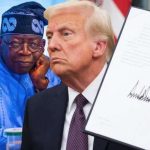
President Donald Trump’s recent post on Truth Social has stirred global attention after he threatened to send U.S. troops to Nigeria “guns-a-blazing” if the killing of Christians in the country continues.
The comment, which came with a warning that U.S. aid to Nigeria could be halted, has sparked questions about whether such an action is legally possible or diplomatically justifiable.
However, under international law, the United States cannot lawfully invade another sovereign nation unless it acts in self-defence or receives authorization from the United Nations Security Council.
The UN Charter prohibits the use of force against other member states except under these narrow exceptions.
An invasion for humanitarian reasons or in response to internal violence would not, on its own, meet those criteria.
Within the U.S. itself, the War Powers Resolution and Constitution restrict the president’s ability to deploy troops unilaterally.
While the president can order limited or emergency military actions, any extended campaign or invasion must receive Congressional approval.
In practice, this means a decision to send American forces into Nigeria would face serious legal and political hurdles in Washington.
Historically, the U.S. has undertaken limited counterterrorism operations abroad, such as drone strikes or special forces missions in countries like Pakistan, Syria, and Somalia but rarely full-scale invasions without international backing.
Even those smaller operations often drew criticism over sovereignty and legality.
International law experts note that while Washington can choose to suspend aid, impose sanctions, or exert diplomatic pressure to push for greater protection of religious freedom, a military invasion of Nigeria would violate international norms and risk severe geopolitical fallout.
For now, President Trump’s threat appears to serve more as a strong political message to Nigeria’s leadership than an imminent military plan.
However, it indicates growing U.S. concern over reports of religiously motivated violence and the protection of minority communities in Africa’s most populous nation.