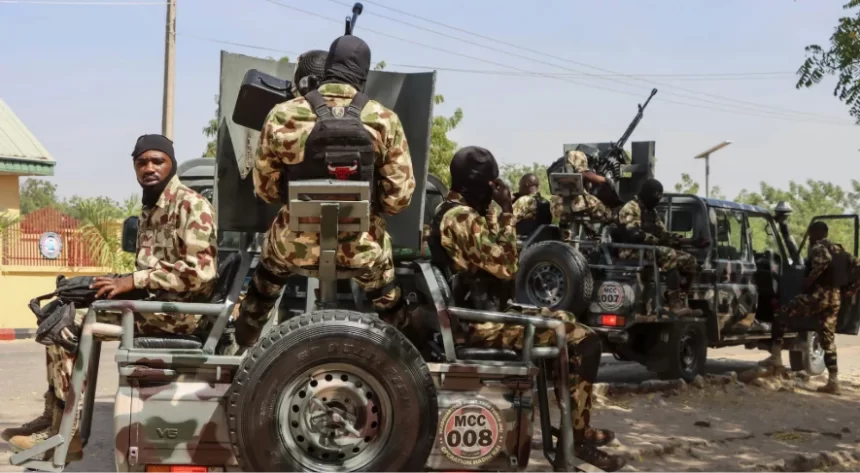
In 2025, the Nigerian federal government approved an unprecedented ₦4.9 trillion allocation for national defence and security. By 2026, this figure surged even higher to an estimated ₦5.41 trillion, marking a dramatic recalibration of national fiscal priorities amid a devastating national crisis. Over the past 15 years, Nigeria has sunk over ₦32 trillion into its defence sector, an amount that dwarfs the entire annual GDP of several African nations. Yet, every day, the headlines are dominated by harrowing tales of violent attacks, displacing thousands of citizens, shutting down schools, and bringing regional economies to their knees.
The core question every taxpayer, policymaker, and grieving family is asking is this: Is this record-breaking financial commitment actually translating into public safety, or are we simply funding an unoptimized bureaucratic machine? To understand this, one must rigorously examine the security situation in Nigeria: Buhari legacy vs Tinubu’s 3 years to determine if throwing money at the problem is actually curbing the violence.
The Security Situation in Nigeria: Buhari Legacy vs Tinubu’s 3 Years
When attempting to map out the current trajectory of the nation’s stability, comparing the previous administration’s tenure with the current reality is unavoidable. The contrast and continuity between the two regimes offer a sobering look at how deeply rooted the country’s security vulnerabilities are.
The Buhari Era: A Shift to Asymmetric Warfare
Former President Muhammadu Buhari, a retired military general, rode into power in 2015 on the firm promise of crushing the Boko Haram insurgency. During his eight-year tenure, the military successfully recaptured territories previously held by terrorists in the North-East, and global terrorism indices momentarily reflected slight improvements. However, the nature of the threat mutated. The Buhari legacy is characterized by the evolution of traditional insurgency into highly decentralized asymmetric warfare.
While the core Boko Haram faction was fragmented, the nation witnessed a terrifying explosion of banditry and kidnapping across the North-West and North-Central regions. The failure to decisively crush these armed groups led to widespread extortion, the shutdown of crucial farming corridors, and tragic attacks on schools and infrastructure. Reports indicate that thousands of civilians lost their lives during his tenure, while the military was deployed to over 30 states simultaneously, stretching the national security architecture painfully thin.
Tinubu’s 3 Years: Ballooning Budgets, Escalating Crises
Fast forward to mid-2026. President Bola Ahmed Tinubu has been at the helm for roughly three years, and the administration has shown a willingness to fundamentally restructure intelligence and military leadership by replacing service chiefs and declaring nationwide security emergencies. Yet, the empirical data remains grim. Amnesty International reported that over 10,217 people were killed in just the first two years of the Tinubu administration, with independent security analysts estimating the figure has since approached 18,000. Furthermore, Nigeria experienced a staggering 46% increase in deaths from terrorism globally in 2025.
While Tinubu’s administration has aggressively escalated budgetary allocations—culminating in the ₦4.9 trillion 2025 security budget and the subsequent ₦5.41 trillion 2026 budget—the reality on the ground has not proportionally improved. Kidnapping for ransom has become deeply commercialized, and critical infrastructure remains highly vulnerable. The Tinubu administration has attempted to modernize the forces, but critics argue the approach remains too heavily reliant on performative kinetic military action rather than addressing the deeply entrenched causes of internal security breakdowns.
Dissecting the ₦4.9 Trillion Budget: Where is the Money Going?
To understand why a massive ₦4.9 trillion budget isn’t instantly eliminating terrorism, one must look closely at the internal mechanics of the country’s defence expenditure.
Recurrent Expenditure vs. Combat Readiness
A deep dive into the appropriation bills reveals a staggering structural flaw. In both the 2025 and proposed 2026 budgets, the vast majority of the funds are swallowed by recurrent expenditure. Out of the trillions allocated to the Ministry of Defence, over 70% is consistently consumed by personnel costs, salaries, pensions, and administrative overheads.
This leaves a severely disproportionate fraction for actual capital expenditure—the critical funds needed to procure advanced surveillance drones, armored personnel carriers, tactical communications gear, and modern intelligence technology. Consequently, Nigerian soldiers on the frontlines frequently complain of being outgunned by well-funded armed groups who use the untraceable proceeds of ransom payments to purchase highly sophisticated weaponry on the black market.
The Pitfalls of the Envelope Budgeting System
Furthermore, the National Assembly has repeatedly warned against the constraints of the envelope budgeting system. This rigid financial model sets fixed expenditure ceilings for ministries and agencies, depriving intelligence and security forces of the financial flexibility required to execute rapid-response operations. When intelligence agencies face irregular releases of overheads—a concern explicitly raised by the Department of State Services (DSS) and the National Intelligence Agency (NIA) during recent Senate budget defenses—their ability to conduct pre-emptive strikes against terror cells is drastically weakened.
The Human and Economic Cost of Insecurity
It is impossible to view the security budget in isolation without acknowledging the devastating economic impact of insecurity.
A Stranglehold on Agriculture and Investment
The continued proliferation of violence in Nigeria’s agrarian belt has triggered a devastating food crisis. Farmers in Benue, Plateau, Kaduna, and Zamfara states are often forced to pay “harvest taxes” to bandit warlords just to access their own fields. This disruption is a primary driver of the historic food inflation that crippled the economy in recent years, severely neutralizing the economic gains the Tinubu administration hoped to achieve through subsidy removals and monetary policy tightening.
Furthermore, the optics of perpetual violence have severely hampered Foreign Direct Investment (FDI). International investors remain highly hesitant to commit capital to regions where the safety of physical infrastructure and personnel cannot be guaranteed. Adding to the public’s frustration, former presidential candidate Peter Obi recently highlighted the tragic opportunity cost of government spending. He noted that the controversial ₦8 trillion NNPC debt write-off was nearly double the entire ₦4.9 trillion 2025 security budget—funds that could have arguably been used to revolutionize youth employment and starve terror groups of their prime recruitment demographic.
How to Fix Nigeria’s National Security Architecture
We cannot simply spend our way out of this crisis using an outdated, uncoordinated template. To ensure that future budgets actually save lives and restore peace to the nation, several critical paradigm shifts must occur:
- Prioritize Intelligence-Led Policing over Reactionary Deployments:
The military cannot continue to serve as the primary response unit for internal civilian policing. The government must decentralize the national security architecture by massively funding local intelligence-gathering mechanisms and empowering well-regulated, heavily vetted state policing structures to foster community trust. - Restructure Defence Procurement and Capital Allocation:
A transparent, forensic audit of previous defence spending is mandatory. The allocation for capital projects must be expanded and shielded from bureaucratic bottlenecks. This ensures that funds are rapidly deployed to purchase state-of-the-art combat technology rather than disappearing into administrative black holes. - Invest heavily in Domestic Defence Manufacturing:
As defence analysts have frequently pointed out, Nigeria’s growing defence budget must translate into stronger domestic manufacturing capabilities. Continuing to rely heavily on imported military platforms creates a dangerous dependency on foreign suppliers. Fostering local production of military hardware will not only stimulate technological advancement but also isolate national security from foreign exchange volatility. - Address the Root Socio-Economic Causes:
Kinetic military action will never succeed in isolation if the pipeline of disenfranchised, unemployed youth remains wide open. The government must intentionally integrate its security spending with aggressive, grass-roots job creation, localized industrialization, and targeted poverty alleviation programs.
Conclusion
The allocation of ₦4.9 trillion to security in 2025, and subsequent massive increases in 2026, undeniably proves that the federal government recognizes the existential threat facing the nation. However, rigorously analyzing the security situation in Nigeria: Buhari legacy vs Tinubu’s 3 years unearths a sobering reality: unprecedented financial resources without strategic optimization is merely an illusion of progress.
Until the government actively overhauls its procurement processes, abolishes rigid envelope budgeting systems, dramatically improves the ratio of capital to recurrent expenditure, and integrates military action with economic empowerment, the trillion-naira budgets will remain a statistical triumph exclusively on paper. Meanwhile, innocent Nigerian lives will continue to pay the ultimate price on the ground.