President Bola Tinubu has approved a 6-month temporary ban on the export of raw sheanuts to curb informal trade, boost local processing, protect and grow Nigeria’s shea industry.
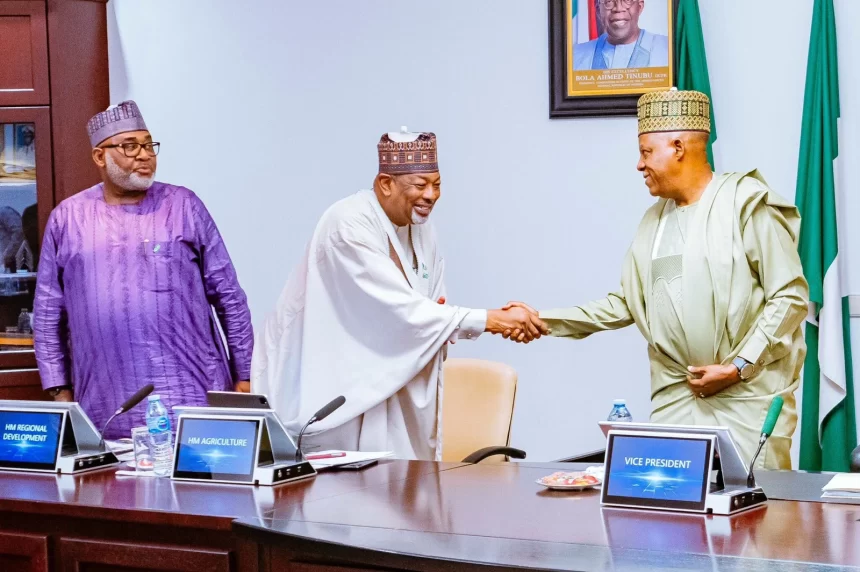
Vice-President Kashim Shettima announced the president’s directive on Tuesday during a multi-stakeholder meeting at the Presidential Villa, Abuja.
9news Nigeria reports that the ban, which is with immediate effect, is subject to review on expiration.
It is aimed at boosting Nigeria’s shea value chain to generate around 300 million dollars annually in the short term.
Shettima explained that the ban was a collective decision involving the sub-nationals and the Federal Government with clear directions for economic transformation in the overall interest of the nation.
He, therefore, called on the Federal Ministry of Finance and other relevant government agencies to fast-track enforcement.
The vice-president said the decision was not “an anti-trade policy” but a pro-value addition policy designed to secure raw materials for processing factories.
He added that the decision would enable industries run at full capacity thereby boosting rural income and jobs for our people.
”The decision will transform Nigeria from an exporter of raw shea nut to a global supplier of refined shea butter, oil and other derivatives, ” he said.
Shettima said it was about industrialisation, rural transformation, gender empowerment and expanding Nigeria’s global trade footprint.
On opportunities for job creation and income generation, the vice-president said, “Nigeria produces nearly 40 per cent of the global shea product.
”Yet, we account for only 1% of the market share of 6.5 billion dollars.
“This is unacceptable. We are projected to earn about $300 million annually in the short term, and by 2027, there will be a 10-fold increase. This is our target.”
He stated that the government was not closing doors; but opening opportunities.
”Mr President is currently in Brazil, and both countries have agreed to prioritize access for Nigerian shea butter and oil into the Brazilian market.
”This process will be completed within the next 3 months,” the vice-president added.
He highlighted the gender dimension of the policy, adding, “by protecting the shea industry, we are protecting livelihoods, dignity and opportunity for millions of our women.
“We are not closing doors, we are opening better ones.
“Today, we plant the seeds of an industry that will yield fruit for decades to come for our women, for our economy, and for Nigeria’s place in global trade.”
The Minister of Agriculture and Food Security, Sen. Abubakar Kyari, said that Nigeria was the world’s largest producer of sheanuts, contributing nearly 40 per cent of the global supply.