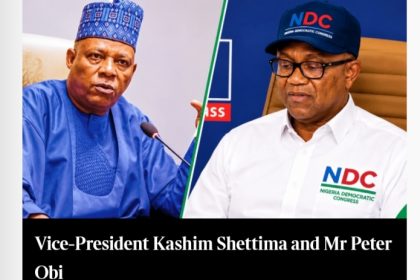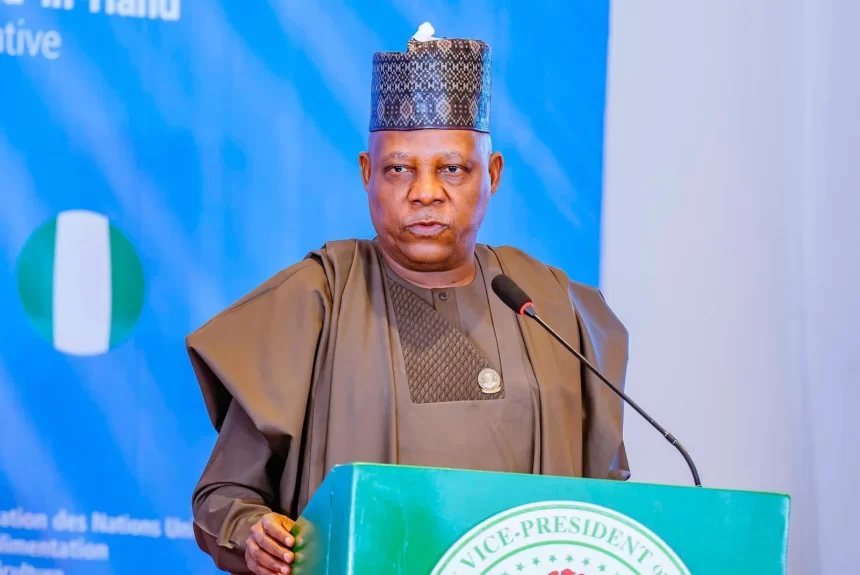
Nigeria’s Vice President, Kashim Shettima in delivering a message on behalf of President Bola Tinubu at the Imo State Economic Stakeholders Summit, praised the Igbo people as “the greatest stakeholders in the Nigerian project,” adding that “half of Abuja is owned by Ndigbo” and that “half of the population of Lagos is largely made up of Ndigbo.”
In essence, the Vice President’s remarks underscore that the Igbo people are not just participants but integral pillars in the Nigerian nation, whose economic contributions and nationwide investments remain central to the country’s unity and development.
Politically, this functions as outreach to the Southeast, recognition that can be read as an attempt to reassure and co-opt a region that has long campaigned for greater inclusion in federal structures.
Such high-profile commendation can lower political temperature, invite cooperation on investments, and create space for federal partnerships with Southeast state governments.
The core of Shettima’s point; that Igbo people are geographically mobile and economically enterprising is supported by academic and economic literature documenting a distinctive Igbo entrepreneurship model (apprenticeship systems, dense trade networks and reinvestment patterns) that has produced strong business clusters across Nigeria’s cities (Onitsha, Nnewi, Aba) and a diaspora within the country’s urban centres.
Those studies explain why public and private investment, retail networks, and property ownership by Igbo traders and professionals are visible in Abuja, Lagos and other states.
Empirically, the claim that “half of Abuja is owned by Ndigbo” is almost certainly rhetorical.
What the claim captures, however, is a widely observed reality: Igbo individuals and businesses have a significant and visible presence in Abuja’s markets, commercial corridors and residential estates.
According to verified sources, the Vice President’s claim hold significant weight in terms of economic footprint.
In policy spheres, if the claim is intended as more than flattery i.e., as a prelude to concrete action, Ndigbo and their representatives can reasonably expect or press for: (a) secure property rights and clear land-title processes in Abuja and other cities; (b) investment incentives and infrastructure support for Southeast states; (c) inclusion in national economic planning and procurement; and (d) protection from harassment and extortion in places where they are a commercial minority.
Shettima’s words create political cover for such policy moves.