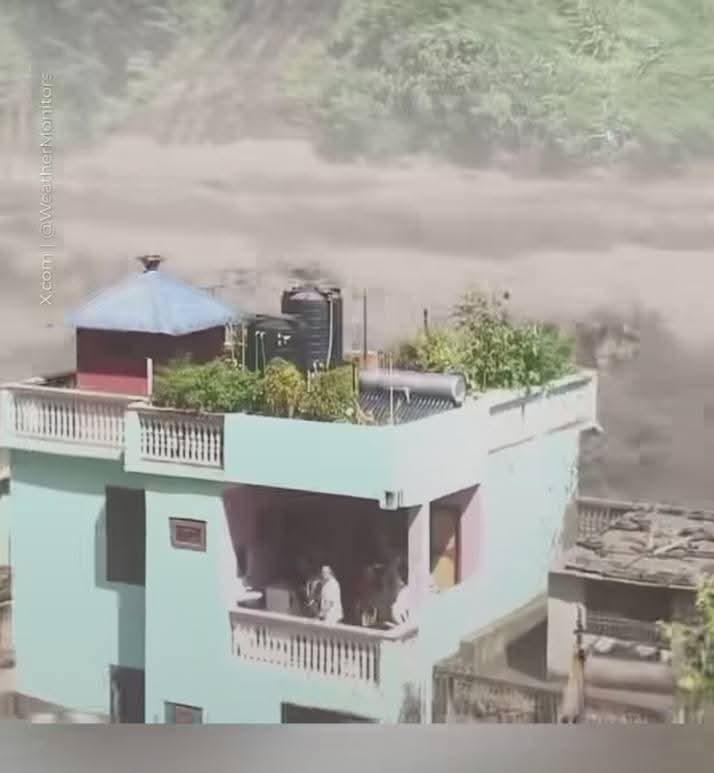
One surviving house amid a raging wall of water is more than a viral image; it is a warning about human vulnerability, nature’s power and the urgent need to prepare for disasters we cannot control.
By Princely Onyenwe | Editorial Desk
The shocking footage of a lone house standing amid raging floodwaters along the Nepal-Tibet border has captured the imagination of people around the world. Surrounded by an enormous volume of water and debris, with people reportedly trapped on rooftops and balconies, the building appears almost impossible to have survived the force unleashed around it.
For many people of faith, such an image naturally evokes thoughts about the power of Almighty God and the mysterious ways in which human lives can be preserved in the midst of destruction. For scientists, however, the same image presents an opportunity to examine how buildings, terrain, water pressure and natural barriers behave under extreme conditions. Both perspectives can coexist: faith may ask why a life was spared, while science seeks to understand how the event unfolded.
But behind the viral image lies a much more devastating human tragedy. Authorities have reported hundreds of deaths and thousands of people missing, while homes, roads, bridges and critical infrastructure have been destroyed or severely damaged. The speed and force of the flooding reportedly left many people with little time to escape.
What makes the catastrophe particularly disturbing is that it was not simply an ordinary case of heavy rainfall overwhelming a river. Scientific assessments indicate that a major glacier collapse or ice-rock avalanche high in the Himalayas triggered a destructive chain of events, sending enormous quantities of water, rock, mud and debris downstream.
Experts have also warned that a warming climate can contribute to the destabilisation of glaciers and high-altitude terrain, although individual disasters require careful scientific assessment before being directly attributed to climate change. This should make governments everywhere rethink what disaster preparedness really means.
The first lesson is simple: nature does not always give humanity sufficient warning. A community can go to bed believing that everything is normal and wake up facing a life-threatening emergency. Disaster management therefore cannot depend entirely on people seeing danger and running for safety. Early-warning systems, emergency communication networks, clearly identified evacuation routes and properly trained response teams must exist before disaster strikes.
The second lesson is that beautiful environments can also be dangerous environments. Mountains, rivers and valleys attract tourists, businesses and communities, but their beauty must never blind people to the risks they carry. Construction and settlement around floodplains, unstable slopes and river channels require serious environmental assessment. Development without proper risk assessment can eventually become a recipe for tragedy.
The third lesson concerns infrastructure. A house that survives while surrounding structures are swept away should prompt serious questions about building standards, foundation design, drainage, location and enforcement. Governments cannot prevent every natural disaster, but they can significantly reduce casualties by ensuring that structures in high-risk areas are properly designed, regulated and located.
There is also a powerful lesson for the developing world: disaster preparedness is not a luxury. It is part of development. However, roads, bridges, hospitals, communication systems and emergency shelters should be designed not merely for normal conditions but also for extreme events. The true test of infrastructure is not how it performs on a peaceful day, but whether it can protect human life when nature becomes hostile.
And there is another warning that should not be ignored: environmental change is becoming a security and humanitarian issue. The Himalayas contain enormous stores of ice that feed some of Asia’s major river systems. Changes in temperature can affect glaciers and high-altitude terrain, creating risks that extend far beyond the mountains themselves. Because rivers cross national boundaries, an environmental disaster in one location can quickly become a regional humanitarian crisis.
The Nepal-Tibet disaster therefore carries a message far beyond the Himalayas. Countries such as Nigeria, which regularly experience devastating floods, should pay attention. The lesson is not that every Nigerian flood will become another Himalayan catastrophe. It is that governments must stop treating flooding as an annual surprise.
Where flood risks are known, drainage systems must be maintained. Where waterways are blocked, action must be taken before the rainy season. Where settlements have become dangerously exposed, governments must consider relocation and enforce planning regulations. And where communities are vulnerable, residents must be educated about evacuation procedures rather than receiving warnings only after water has already entered their homes.
The viral image of the surviving house may eventually disappear from social media, replaced by the next trending story. But the lives lost in the disaster will not become a trend to the families still waiting for their loved ones.
That is perhaps the greatest lesson of all. Human beings may build magnificent cities, powerful machines and sophisticated technologies, but nature continues to remind us that our control has limits. Science can study glaciers, monitor hazards and develop warning systems. Engineering can produce stronger structures. Governments can improve emergency response. Faith can give survivors hope when explanations appear insufficient.
But none of these should encourage complacency. Instead, the tragedy should produce humility. If a single house standing amid a raging flood can make the world stop and wonder, then perhaps the greater miracle would be for humanity to stop merely watching disasters after they happen and begin doing everything possible to prevent avoidable deaths before they happen.
The water will eventually recede. The mud will eventually dry. Roads will be rebuilt and homes reconstructed. But whether the world learns from Nepal and Tibet will determine whether this tragedy becomes only another horrifying chapter in history—or a turning point in how humanity prepares for an increasingly unpredictable natural world.
My sincere sympathy to the affected region and condolences to the families of the deceased.