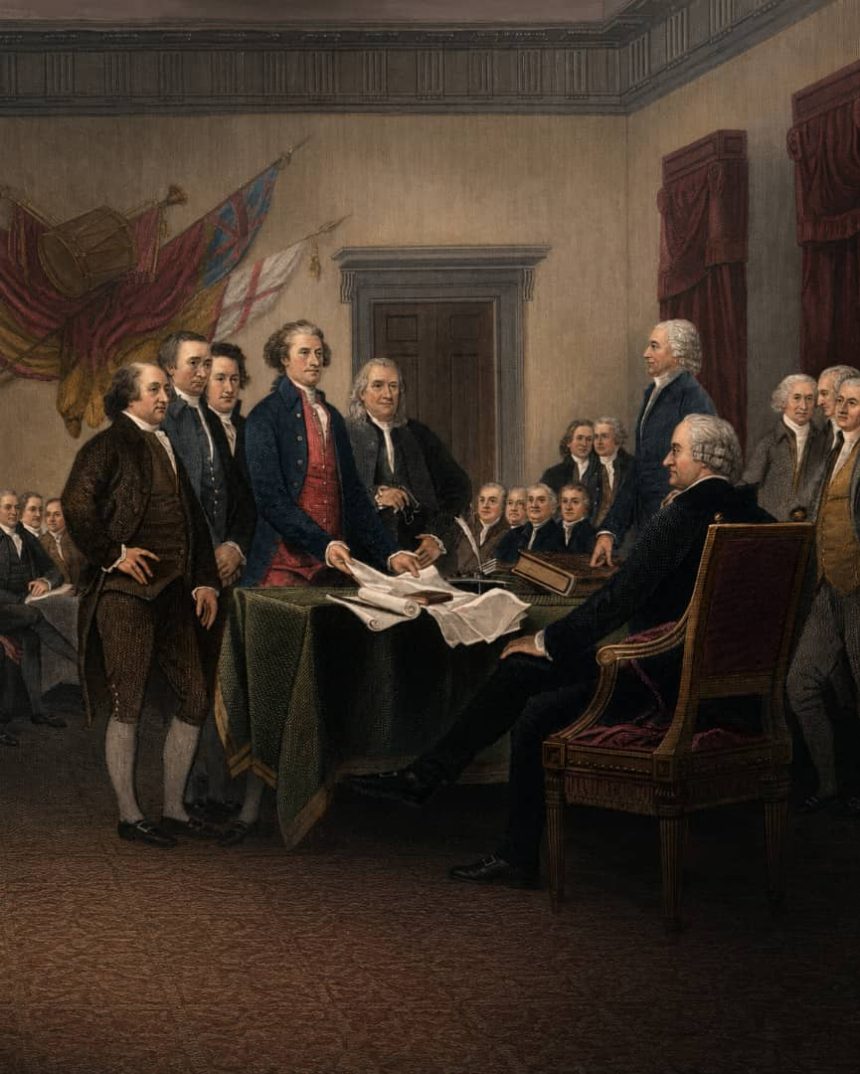
Two hundred and fifty years after America’s Declaration of Independence, the courage of the 56 men who pledged “their Lives, their Fortunes and their sacred Honor” continues to shape democracy, constitutional government and the global struggle for freedom.
By Princely Onyenwe | Editorial Desk
Exactly 250 years ago, delegates of the Second Continental Congress gathered inside the Pennsylvania State House -Known as Independence Hall—in Philadelphia to approve the Declaration of Independence, a decision that would eventually bear the signatures of 56 men and alter the course of world history.
In the eyes of the British Crown, they had committed treason against the most powerful empire of their age. History, however, would remember them not as traitors but as architects of a nation whose founding ideals would influence political thought across continents.
The decision was anything but safe. Britain possessed the world’s most formidable military and naval power, while the thirteen American colonies lacked comparable resources and remained divided over the prospect of independence.
To many observers, the idea that a collection of farmers, merchants, lawyers and statesmen could defeat the British Empire seemed unimaginable. Yet the delegates concluded that the pursuit of liberty demanded greater courage than continued submission to imperial rule.
Their resolve was rooted in ideas that had transformed political thinking throughout the eighteenth century. Enlightenment philosophers championed natural rights, individual liberty and accountable government, while many of the delegates also drew moral conviction from their Christian faith and other religious traditions. Together, these influences produced a revolutionary belief: that governments derive their legitimacy from the consent of the governed rather than from hereditary power or absolute monarchy.
The Declaration of Independence became far more than a formal separation from Britain. It articulated universal principles that would inspire reformers, revolutionaries and constitution-makers across the globe. From Europe to Latin America, and from Africa to Asia, generations seeking self-government found encouragement in the proposition that liberty is an inherent human right rather than a privilege bestowed by rulers.
The Revolutionary War that followed tested those ideals with extraordinary sacrifice. Thousands lost their lives, communities were devastated and fortunes vanished. The men who eventually signed the Declaration understood the consequences of failure. Had Britain prevailed, many would almost certainly have faced execution for treason. Their signatures represented an uncommon willingness to place principle above personal safety.
History, however, demands honesty alongside admiration. The United States that emerged from independence did not immediately fulfil all the ideals proclaimed in the Declaration. Slavery persisted, women remained excluded from political participation, and Indigenous peoples continued to suffer displacement and injustice. America’s democratic journey has therefore been one of continual effort to reconcile its founding promises with the realities of its history.
These contradictions do not diminish the Declaration’s enduring significance. Rather, they illustrate that great national ideals are rarely achieved in a single generation. Democracy is strengthened through constant reform, resilient institutions, an independent judiciary, a free press and the willingness of successive generations to confront injustice while preserving constitutional order.
As the United States commemorates the 250th anniversary of its Declaration of Independence, the milestone offers lessons far beyond American shores. It is more than a celebration of history; it is an invitation for democracies around the world to examine the strength of their institutions, the accountability of their leaders and their commitment to the rule of law. Enduring democracies are sustained not by patriotic rhetoric alone but by transparent governance, civic participation and respect for constitutional principles.
For Nigeria and other developing democracies, the story of Philadelphia should not be viewed as a blueprint to imitate but as evidence that enduring nation-building depends on ideas, institutions and principled leadership rather than temporary political victories. History shows that nations are transformed not by stirring speeches alone but by justice, accountability, responsible governance and public trust.
Two and a half centuries later, the Declaration of Independence remains one of humanity’s defining political milestones. It reminds the world that history is often changed by ordinary individuals prepared to make extraordinary sacrifices for principles they believe should outlive them.
The events in Philadelphia did more than give birth to a new nation; they reshaped global political thought and continue to challenge every generation to defend liberty with wisdom, integrity and responsibility.
Note: July 4, 1776: Thirteen (13 ) American colonies declared independence from Great Britain.
The 13 American Colonies that declared independence on July 4, 1976 are as follow:
New England Colonies
- New Hampshire
- Massachusetts
- Rhode Island
- Connecticut
Middle Colonies
- New York
- New Jersey
- Pennsylvania
- Delaware
Southern Colonies
- Maryland
- Virginia
- North Carolina
- South Carolina
- Georgia
These 13 colonies came together as the “United States of America” after the Declaration of Independence. The Declaration was actually drafted mainly by Thomas Jefferson, and signed in Philadelphia. John Hancock’s big signature on it is the most famous one. I congratulate America.